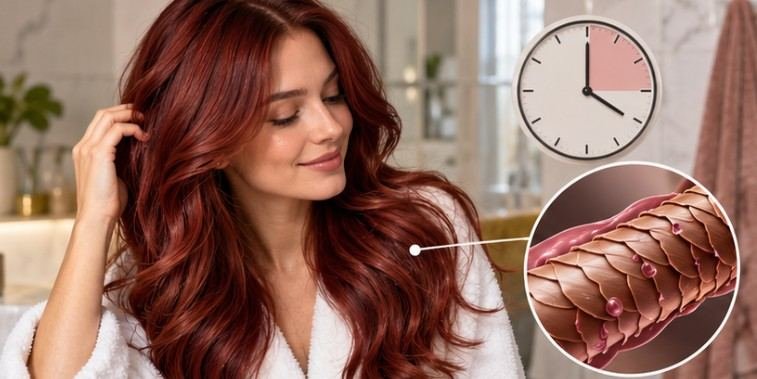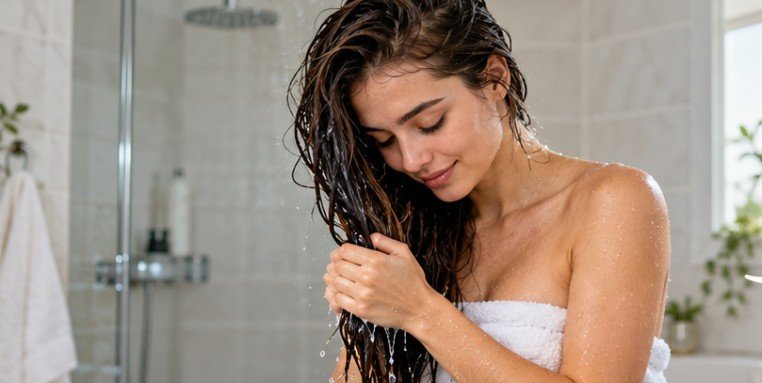
Hair can absorb enough water to swell and become temporarily more vulnerable to stretching, friction, and breakage. That is one reason simply skipping the blow-dryer does not automatically produce smooth hair. If soaking-wet strands are rubbed with a towel, repeatedly brushed, or handled while drying, the result can still be a halo of frizz.
Learning how to dry hair without heat without frizz is therefore less about doing nothing and more about controlling what happens between the shower and completely dry hair. The best routine removes excess water gently, adds slip while strands are damp, encourages the hair to dry in its natural pattern, and then leaves it alone.
Why Air-Dried Hair Sometimes Turns Frizzy
A strand of hair is covered by overlapping cuticle cells that protect the inner fiber. Water enters the hair shaft during washing and causes it to swell. Research on hair-fiber structure has found that repeated water exposure, friction, grooming, and chemical processing can contribute to progressive cuticle damage and roughness.
That matters because a rougher surface catches against neighboring strands instead of lying smoothly beside them.
Humidity adds another variable. Hair continually exchanges moisture with the surrounding air, so naturally porous, bleached, chemically processed, or already damaged strands may respond more noticeably when humidity rises.
Heat is not the only potential source of damage either. The American Academy of Dermatology advises minimizing rough towel drying and unnecessary handling of wet hair because wet strands can be especially vulnerable to breakage. The goal, then, is not merely to air-dry. It is to air-dry with as little friction and disruption as possible.
Start the Frizz-Control Process in the Shower
Your drying method works better when your hair leaves the shower properly conditioned.
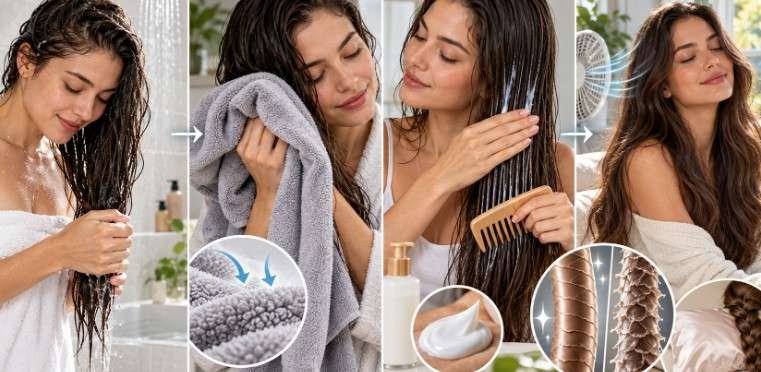
Apply shampoo mainly to the scalp rather than aggressively scrubbing the lengths. Let the lather rinse through the rest of the hair. Follow with conditioner, concentrating it wherever your hair tends to become dry or tangled.
Use warm or lukewarm water rather than an extremely hot shower. Very hot water can contribute to dryness, while Cleveland Clinic dermatology guidance notes that excessive washing and hair damage can make strands more vulnerable to frizz and breakage.
A quick cool rinse at the end is optional. It may make freshly conditioned hair feel smoother, but think of it as a finishing step rather than a magic technique that permanently “closes” every cuticle.
The No-Heat Air-Dry Routine That Reduces Frizz
Remove Water Before Reaching for a Towel
When you turn off the shower, gently squeeze sections of hair between your hands. Do not twist the lengths into a rope or wring them aggressively. Removing this first layer of water means your towel has less work to do.
Blot With Microfiber or a Cotton T-Shirt
A plush bath towel may feel soft against skin but can create unnecessary friction against wet strands. Instead, press a microfiber hair towel or clean cotton T-shirt around the hair. Squeeze gently and move to another section rather than rubbing back and forth.
University of Utah Health specifically recommends blotting wet hair with microfiber or a T-shirt rather than rubbing it, because wet hair is more fragile and susceptible to mechanical damage. University of Utah Health wet-hair guidance. Aim for damp hair, not towel-dried hair that already feels nearly dry.
Apply Leave-In Products While Hair Is Still Damp
This is one of the most important timing details. A leave-in conditioner, lightweight smoothing cream, curl cream, or air-dry product spreads more evenly when there is still water in the hair. That moisture helps distribute the product instead of allowing concentrated patches to sit on partially dried strands.
Fine hair usually needs less product. Start with a pea-sized or dime-sized amount through the mid-lengths and ends. Thick, coarse, curly, or highly porous hair may need more conditioning and stronger hold to prevent expansion as it dries.
Detangle According to Your Hair Type
Wet hair requires thoughtful handling rather than a universal rule. For straight or loosely wavy hair, allow some moisture to leave before gently working through tangles with a wide-tooth comb, beginning at the ends.
For curly and tightly textured hair, detangling while the hair is wet and slippery with conditioner is often preferable because brushing once curls begin setting can separate the pattern and create frizz.
The American Academy of Dermatology similarly recommends adjusting wet-hair detangling to texture rather than treating every hair type identically.
Set the Shape Before You Stop Touching It
Once the hair is detangled and coated with your chosen product, encourage the pattern you want before drying begins.
For straight hair, comb it into place and let it fall naturally.
For waves, gently scrunch upward.
For curls, scrunch or finger-coil sections that tend to lose definition.
For coily hair, twists, braids, or another low-tension stretching method can create a controlled shape without heat.
Then stop manipulating it.
Every time you rake your fingers through partially dry hair, separate clumps, or repeatedly reposition strands, you interfere with the pattern forming as moisture leaves.
Match the Method to Your Hair
| Hair type | Best air-drying approach | Common mistake |
| Fine or straight | Light leave-in, gentle combing, minimal product | Heavy creams that flatten roots |
| Wavy | Lightweight conditioner plus scrunching | Brushing after waves begin forming |
| Curly | Apply product very wet and preserve curl clumps | Constant touching while drying |
| Coily | Moisture plus controlled twists or braids | Tight styles on fragile wet hair |
| Bleached or damaged | Extra conditioning and very low friction | Aggressive towel drying |
Your routine may also need adjustment if your home’s water contains significant calcium and magnesium. Penn State Extension explains that these minerals are what create hard water and can interfere with soaps and detergents.
If your hair consistently feels coated, stiff, dull, or unusually tangled after washing, consider whether hard water is affecting your hair before blaming your air-drying technique.
What to Do When You Need Hair to Dry Faster

Airflow matters. Instead of piling wet hair into a thick bun for hours, spread it across your shoulders or arrange it so air can circulate around more of the surface. A ceiling fan or normal room fan can speed evaporation without applying high heat directly to the hair.
Changing your part after the roots have partially dried can also expose damp sections. If you wash at night, avoid going to sleep with soaking-wet hair whenever possible. Damp strands rubbing repeatedly against a pillow experience extra friction. Sleeping with wet hair tightly secured in a bun can add tension as well.
If overnight drying is unavoidable, let the hair become mostly dry first and use a loose style with a satin or silk pillowcase.
Troubleshooting Frizz After Air-Drying
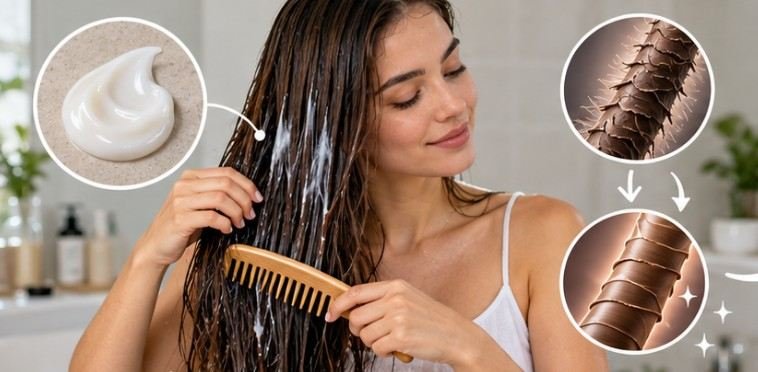
If the roots look smooth but the ends become fluffy, your ends probably need more conditioning or less towel friction.
If the entire head expands as it dries, try applying styling product earlier while the hair contains more water. If curls look defined when wet but fuzzy once dry, stop touching them during the drying stage and consider a styling product with more hold. If your hair feels oily or coated rather than frizzy, you may be using too much leave-in product.
Persistent breakage is different from cosmetic frizz. MedlinePlus recommends seeking medical advice when dry or fragile hair does not improve with gentler care or when significant breakage or hair loss accompanies it.
For people trying to retain length, reducing breakage can be just as important as supporting healthy growth habits. Our guide to helping hair grow and retain length explains that distinction in more detail.
FAQs
1. Is air-drying always healthier than blow-drying?
Not automatically. Air-drying removes high heat, but aggressive towel rubbing, brushing, tight wet hairstyles, and prolonged friction can still damage vulnerable strands.
2. Should I brush my hair while it air-dries?
Usually not repeatedly. Straight hair can be gently detangled after it partially dries, while curly or coily hair is generally easier to detangle while wet and conditioned.
3. Does cold water completely stop frizz?
No. A cool rinse may feel refreshing and help hair feel smoother, but conditioning, low friction, proper product application, and minimal handling have a much larger influence on the final result.
4. Why does my hair become frizzier as it gets almost dry?
Partially dry strands are beginning to set into their final pattern. Touching, brushing, separating, or rubbing them at this stage can disturb that pattern and create flyaways.
The Smoothest Air-Dry Starts Before Hair Feels Dry
The biggest mistake in how to dry hair without heat without frizz is assuming that air-drying means leaving soaking-wet hair completely unmanaged.
Smooth results are created during the first few minutes after washing. Remove water gently, condition while strands are still damp, detangle according to your texture, set the shape you want, and then give your hair time to dry without interference.
The method is remarkably simple once friction is removed from the equation. Your towel, hands, brush, water quality, and styling timing can influence the result just as much as the absence of a hair dryer.