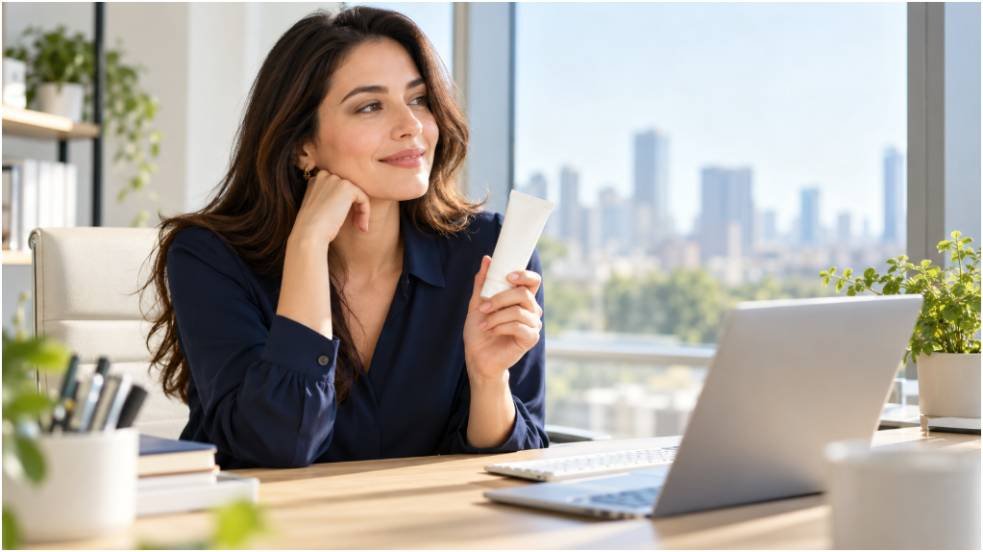
Sitting eight hours beneath fluorescent office lighting next to a sealed, double-pane window taught me a frustrating lesson: desks ruin sunscreens faster than beach days. By 2:00 PM, recirculated office air conditioning dries out your cheeks while your forehead turns into an oily, slick mess that dissolves your foundation. Finding a true lightweight non greasy sunscreen for daily office wear is not just about avoiding a chalky white cast; it is about finding a protective film that balances forced HVAC drafts, screen exposure, and cosmetic layering.
I spent months testing popular US formulas directly at my desk, monitoring oil production with blotting papers and tracking midday foundation pilling. Here is how four leading daily sunscreens hold up to corporate cubicles, dry vents, and full makeup wear.
The Office Climate Problem: Why Standard Sunscreens Melt by 2 PM
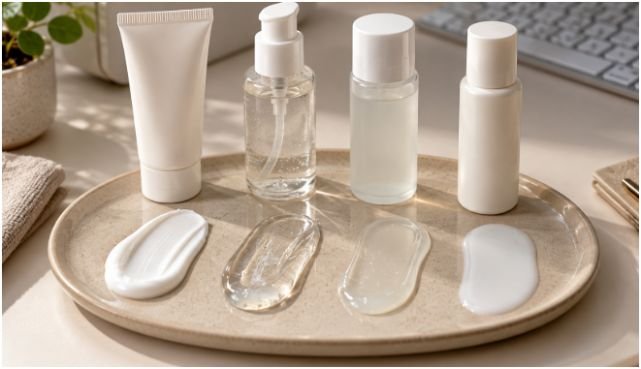
Most people assume staying indoors all day means sunscreen is optional. In reality, commercial office buildings present a hostile microclimate for facial skin.
Recirculated HVAC Air and the Sebum Rebound Effect
Corporate HVAC systems pull moisture from the air to maintain regulated indoor temperatures, frequently dropping interior relative humidity below 30%. When ambient humidity plummets, your epidermis experiences rapid trans-epidermal water loss. In self-defense, your sebaceous glands overcompensate by releasing excess sebum.
If you apply a thick, emollient sunscreen, this flood of natural oils mixes with heavy emulsifiers. The result is midday slip, clogged pores, and slick patches around the nose. Keeping your moisture balance stable is essential; if you stripped your barrier with harsh exfoliants over the weekend, you will need to repair damaged skin moisture barrier quickly so your skin tolerates daily chemical and physical UV filters without stinging.
Standard Window Glass Still Passes UVA Rays
Standard commercial building glass filters out UVB rays—the wavelengths responsible for sunburns—but allows up to 75% of UVA rays to pass straight through, as documented by the Skin Cancer Foundation. UVA rays penetrate deeply into the dermis, accelerating photoaging, breaking down collagen, and worsening hyperpigmentation while you type away at your computer.
Furthermore, prolonged exposure to high-energy visible (HEV) blue light from high-output computer monitors exacerbates pigmentary disorders in melasma-prone skin. Daily facial SPF is mandatory even when you never step outside for lunch.
How I Wear-Tested 4 Top Lightweight Formulas Under Fluorescent Lights
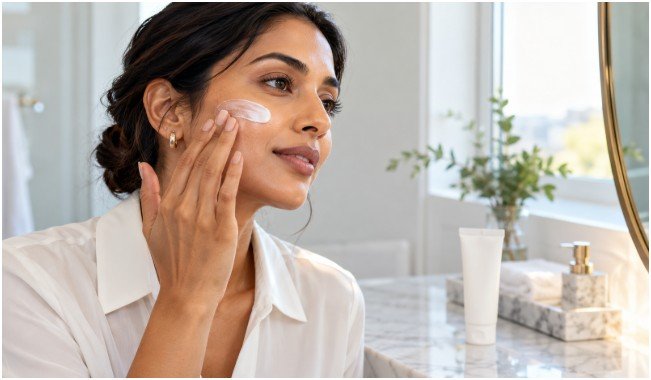
I evaluated four widely available formulas across four specific metrics: dry-down speed, tactile oiliness after four hours, compatibility under liquid foundation, and eye-stinging potential during screen time.
EltaMD UV Clear Broad-Spectrum SPF 46: Best for Redness-Prone Skin
EltaMD UV Clear remains a gold standard in dermatology clinics for a distinct reason. Its formula pairs 9.0% transparent zinc oxide with 7.5% octinoxate, creating a hybrid barrier that deflects UV rays without leaving a pasty, opaque film.
- Active Actives & Tech: Formulated with 5% high-purity niacinamide, hyaluronic acid, and lactic acid. Clinical evaluations published in the National Center for Biotechnology Information confirm that topical niacinamide significantly reduces sebum excretion rates while strengthening stratum corneum integrity.
- Office Wear Performance: During my wear tests, the fluid took 90 seconds to settle into a satin, skin-like finish. The niacinamide visibly calmed capillary flushing caused by hot office radiators. It never settled into smile lines or stung my eyes while staring at spreadsheets.
- Pricing & Availability: Retails around $44.00 for 1.7 oz at Dermstore, Ulta Beauty, and authorized medical spas.
Trader Joe’s Daily Facial Sunscreen SPF 40: Best Velvet-Matte Makeup Primer
Trader Joe’s disrupted the skincare market with this transparent anhydrous gel. Built on a matrix of dimethicone cross-polymers and chemical UV filters (avobenzone, homosalate, octisalate, octocrylene), it functions identically to high-end gripping primers.
- Formula Feel & Texture: Completely clear, scent-free, and anhydrous (water-free). It glides across skin like silk, filling in rough texture and enlarged pores instantly.
- Office Wear Performance: If you struggle with an oily T-zone by 3 PM, this formula locks oil down better than traditional liquid lotions. It contains no water, meaning it does not evaporate or disrupt foundation pigment. In my testing, makeup applied over this gel stayed intact through nine hours without separating.
- Pricing & Availability: Sells for $8.99 in-store at Trader Joe’s nationwide.
Neutrogena Hydro Boost Water Gel Lotion SPF 50: Best for HVAC-Induced Dryness
If your skin feels parched and tight by early afternoon due to dry vents blowing directly at your desk, this water-gel lotion acts like an ambient hydration cushion.
- Active Actives & Tech: Formulated with cross-linked hyaluronic acid and glycerin. It relies on a water-burst emulsion system that releases moisture upon contact with skin friction.
- Office Wear Performance: Unlike heavy moisturizing sunscreens, this lotion has a weightless water-gel consistency. It absorbs within 45 seconds, imparting a subtle cooling sensation. It leaves a natural dewy finish without feeling tacky or greasy when touching your face. It keeps skin bouncy in arid cubicles, eliminating the dry, crepey look that powdery sunscreens produce under makeup.
- Pricing & Availability: Approximately $15.00 to $19.99 across Target, Walgreens, and CVS.
La Roche-Posay Anthelios Ultra Light Fluid SPF 60: Best Weightless Shield
For skin that breaks out from rich creams, this French-engineered fluid delivers broad-spectrum protection in an ultra-runny, milk-like vehicle.
- Active Actives & Tech: Employs silica-infused volatile carriers and photostable Cell-Ox Shield technology. Research featured in the Journal of the American Academy of Dermatology highlights how engineered volatile carriers evaporate cleanly upon skin application, fixing UV filters evenly across skin topography without occlusive weight.
- Office Wear Performance: This formula requires shaking before application. It pours out like skim milk and dries instantly to a soft-focus matte veil. Because the carrier fluid evaporates rapidly, it never travels into the conjunctiva or causes stinging eyes during high-concentration monitor work.
- Pricing & Availability: ~$35.99 for 1.7 fl oz at Ulta Beauty, CVS, and Target.
How to Layer SPF Under Cosmetics Without Pilling
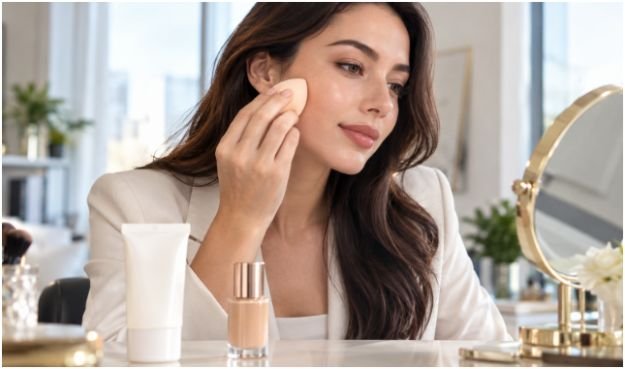
Product pilling occurs when polymers, silicones, and water bases clash and roll into tiny rubbery pills across your jawline. You can avoid this by matching formulations:
- Wait Three Full Minutes: Let your sunscreen form an uninterrupted chemical film before grabbing your makeup sponge. Rushing this step dilutes the filters and causes blotchy foundation coverage.
- Match Base Formulations: Pair silicone-heavy sunscreens (like Trader Joe’s SPF 40) with silicone-based liquid foundations. Pair water-gel sunscreens (like Neutrogena Hydro Boost) with water-based cosmetics or skin tints.
- Streamline Your Morning Skincare: Do not pile on rich morning creams. Instead, learn how to layer serums for glass skin look using weightless humectants like glycerin and polyglutamic acid, letting your SPF serve as your daytime protective seal.
Stop the 3 PM Slicks: Clock Out Without the Grease
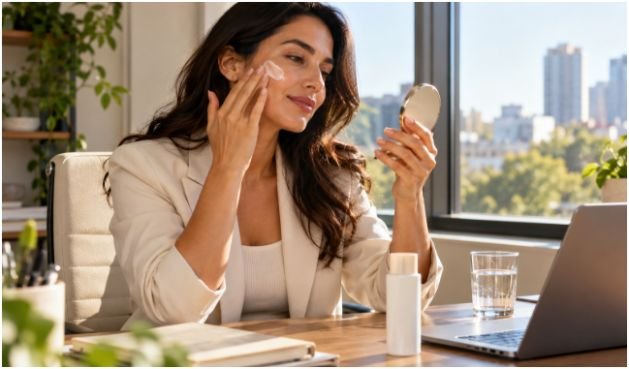
You do not need to settle for an afternoon grease slick just to shield your skin from indoor windows and blue light. Swapping heavy, beach-oriented lotions for a specialized, fast-absorbing fluid turns sun protection into an effortless desk habit. Pick the silicone gel matrix if your foundation tends to slide off your nose by lunchtime, or reach for a niacinamide-rich fluid if office heating triggers midday redness.
Keep a dedicated bottle directly at your workstation. When your afternoon break hits, apply a fresh pump over high cheekbones, grab some water, and finish your workday protected.
Frequently Asked Questions About Office Sun Protection
1. Do I really need sunscreen if I sit away from the window?
Yes, standard fluorescent lights emit trace UVA, and high-energy visible light from monitors can stimulate pigment production in sensitive complexions.
2. How do I reapply sunscreen over full foundation at my desk?
Use an SPF 50 setting powder or tap an SPF cushion compact over high points of your face with a dry blender sponge.
3. What ingredients prevent sunscreen from feeling greasy?
Formulations containing silica, tapioca starch, dimethicone crosspolymers, and high-purity niacinamide dry down quickly and curb midday oil production.
4. Will a lightweight chemical sunscreen pill under tinted moisturizer?
No, provided you allow the chemical sunscreen to absorb completely for 3 to 5 minutes before tapping on your tinted moisturizer.