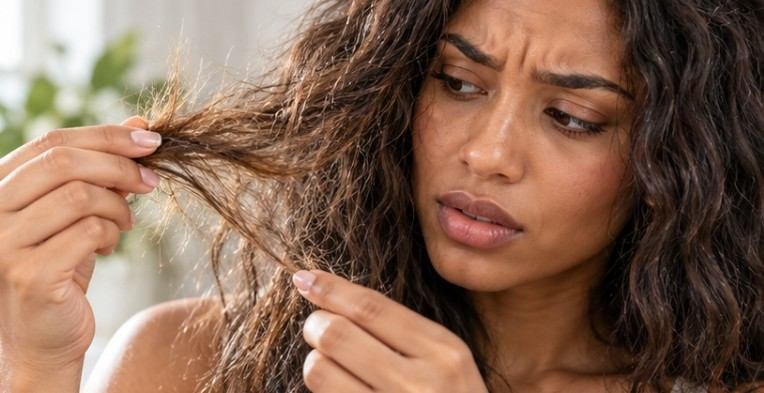
Here is the surprising part: “protein overload” is not a recognized medical diagnosis, yet the brittle, rough, strangely stiff hair people associate with it can absolutely be real.
So, is protein overload real for hair? Not quite in the way social media often describes it. Hair does not simply absorb protein until it becomes dangerously “overfilled.” What can happen is more complicated: protein-containing products may deposit on the hair surface, interact differently with damaged versus healthy strands, and contribute to a stiff or coated feel when the overall formula or routine does not suit your hair.
Understanding that difference matters because treating the wrong problem can make already-fragile hair worse.
What People Mean by “Protein Overload”
In hair-care communities, protein overload usually describes hair that suddenly becomes unusually dry, rigid, tangled, dull, or prone to snapping after repeated use of protein-rich products.
Common ingredients blamed include hydrolyzed keratin, wheat protein, rice protein, silk protein, collagen, amino acids, and other protein derivatives.
The symptoms are believable. The proposed mechanism—that hair somehow stores excessive protein until it becomes overloaded—is much less straightforward.
The hair shaft itself is already largely composed of keratinized material. DermNet explains that the cuticle consists of dead, flattened cells and is heavily keratinized. Once hair emerges from the scalp, it cannot biologically heal itself like living skin can.
That means cosmetic treatments mainly change the physical properties and surface behavior of existing hair fibers rather than “feeding” them.
What Hair Proteins Actually Do
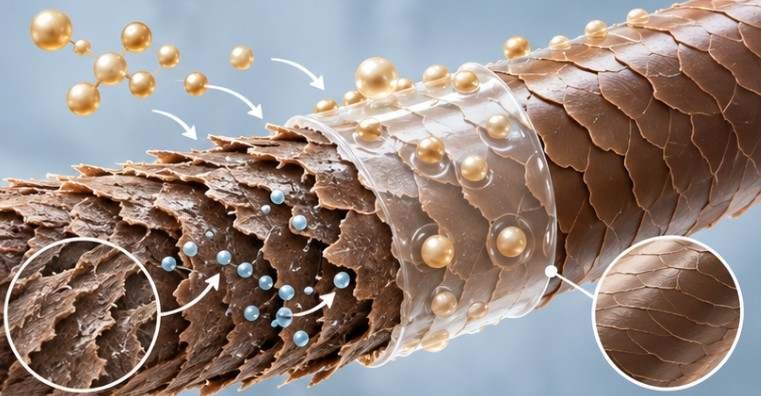
Protein ingredients are not useless. In fact, research suggests they can be particularly valuable for chemically damaged hair.
A study indexed by the National Library of Medicine examined hydrolyzed keratins of different molecular weights on relaxed textured hair. Low- and medium-molecular-weight compounds penetrated more deeply into the cortex, while larger keratin peptides were primarily deposited on the surface. Some treatments improved mechanical properties and reduced breakage under the study conditions.
More recent research on hydrolyzed keratin similarly found that it could form a film on the cuticle while some material entered the cortex. Treated fibers also retained better tensile properties after ultraviolet exposure than untreated samples.
In other words, protein-containing treatments can temporarily reinforce weak areas, change how the strand behaves, and improve strength under certain circumstances. But more treatment is not automatically better.
Why Hair Can Feel Worse After Protein Products
The better question than is protein overload real for hair may be: Why does my hair become hard and brittle after I use protein? Several possibilities deserve consideration.
The Formula May Be Too Strengthening for Your Hair
A highly damaged, bleached strand and an untreated, low-damage strand do not necessarily need the same conditioning system.
Protein derivatives can increase rigidity or alter tensile characteristics. That can be helpful when weakened hair needs reinforcement, but someone whose hair already feels relatively strong may dislike the resulting texture.
This is why ingredient lists alone cannot predict whether a product will work. The amount, molecular size, conditioning ingredients, formulation, frequency of use, and condition of your hair all matter.
You May Actually Have Product Buildup
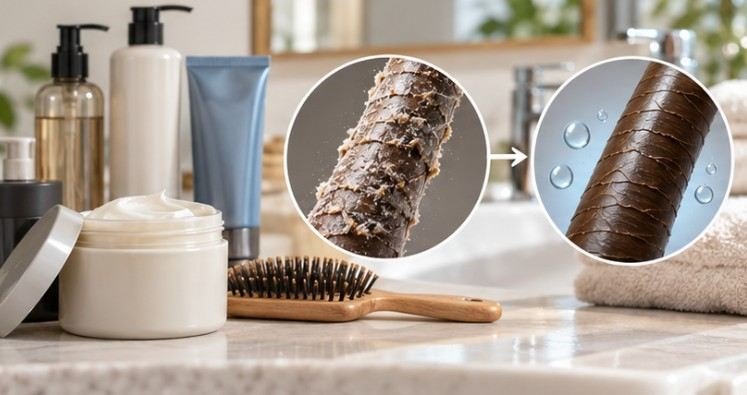
Conditioners, styling polymers, oils, silicones, dry shampoo, mineral deposits, and protein-containing products can all contribute to a coated sensation.
DermNet notes that protein derivatives may temporarily patch damaged areas and that silicones can form films that reduce friction and breakage. Film formation is useful, but layers of products can change how hair feels.
The American Academy of Dermatology also recommends shampooing the scalp to remove accumulated products, oil, and dead skin rather than continually layering products over them.
Existing Damage May Be the Real Problem
Bleaching, permanent color, chemical straightening, repeated hot-tool use, tight hairstyles, aggressive brushing, and UV exposure can weaken the hair shaft. Damaged hair is inherently more likely to feel rough and break.
The American Academy of Dermatology warns that excessive heat, chemical processing, rough handling, and tension can make hair fragile enough to break. If strands are already compromised, blaming the most recent protein mask can overlook months or years of accumulated damage.
For persistent snapping, this guide to hair breakage treatment can help you look at the larger pattern rather than focusing on one ingredient.
A Simple At-Home Troubleshooting Test
There is no scientifically validated home “protein overload test.” The popular stretch test—pulling a wet strand to diagnose its protein-moisture balance—is especially easy to overinterpret.
A better approach is controlled elimination.
| What you notice | More likely explanation | First move |
| Hair became stiff after starting a protein treatment | Product or formulation mismatch | Stop it temporarily |
| Hair feels coated and heavy | Product buildup | Wash thoroughly |
| Hair snaps after bleaching or heat styling | Structural damage | Reduce chemical and heat stress |
| Hair feels tangled and rough | Insufficient conditioning or damage | Add conditioner and gentle handling |
| Breakage continues despite routine changes | Hair/scalp disorder may be involved | See a dermatologist |
Start by removing dedicated protein treatments from your routine for two to three washes. Continue using a gentle shampoo and a well-formulated conditioner.
If your hair feels coated, use an appropriate cleansing shampoo rather than repeatedly applying deep masks. Then keep styling simple for several wash cycles.
If softness and flexibility return after removing one particular product, that product probably was not a good fit. You do not need to prove that protein itself was responsible.
Do You Need a “Protein-Free” Routine?
Usually, no. Seeing hydrolyzed keratin or another protein on an ingredient label does not automatically mean the product will make your hair brittle. Formulation matters far more than the presence of a single ingredient.
Damaged, chemically processed, relaxed, or highly porous hair may respond especially well to strengthening products. Research on keratin-treated damaged fibers has demonstrated measurable improvements in mechanical properties under laboratory conditions.
Instead of banning proteins indefinitely, judge products by results. If a product consistently leaves your hair soft, manageable, and less prone to breakage, there is little reason to stop using it simply because protein appears on the label.
Protect the Hair You Already Have
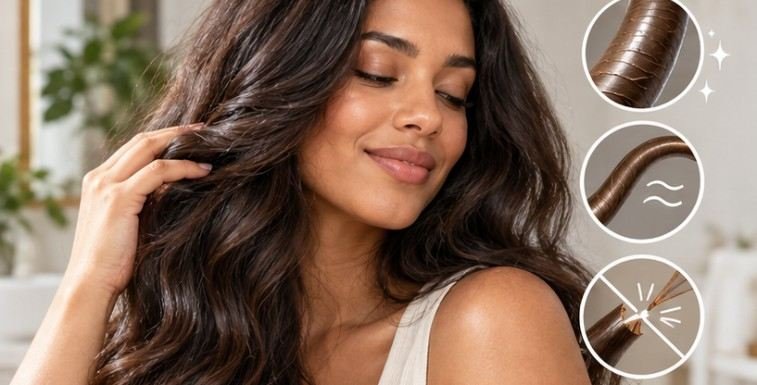
Whether protein is involved or not, preventing additional damage is usually more productive than trying to achieve a perfect theoretical “protein-moisture balance.”
Condition after shampooing, reduce unnecessary heat, handle wet hair gently, avoid aggressive brushing, and space out chemical treatments. The AAD notes that conditioner coats hair strands and can help reduce breakage and split ends.
The FDA also advises consumers to stop using a cosmetic product if it causes an unexpected reaction and contact a healthcare professional when appropriate. Hair loss, breakage, itching, and scalp reactions have all appeared in adverse-event reports involving hair products, although an association does not automatically prove that a particular ingredient caused the problem.
If sudden shedding rather than snapping is the issue—particularly after pregnancy—it is worth distinguishing shaft breakage from shedding at the follicle. Our guide to postpartum hair loss remedies explains that difference.
When It Is More Than a Product Problem
Persistent breakage deserves attention if changing your routine does not help. DermNet notes that acquired hair-shaft abnormalities may result from physical or chemical injury, but genetic and medical hair-shaft disorders also exist.
Seek a board-certified dermatologist if you notice bald areas, significant thinning, scalp pain, burning, intense itching, unexplained shedding, or breakage that continues despite gentler care. Check for symptoms of protein deficit hair
Frequently Asked Questions
1. Is protein overload real for hair?
The symptoms are real, but “protein overload” is not a formal medical diagnosis. Stiffness and breakage may instead reflect product buildup, unsuitable formulations, insufficient conditioning, or existing chemical and mechanical damage.
2. How do I know if my hair dislikes protein?
Watch for a repeatable pattern. If your hair becomes noticeably stiff, rough, or difficult to manage every time you use a particular protein treatment, stop that product temporarily and reassess after several washes.
3. Can shampoo remove excess protein from hair?
Protein and other conditioning materials deposited on the hair surface can often be reduced through cleansing. However, shampoo cannot reverse structural damage already caused by bleaching, heat, chemicals, or mechanical stress.
4. How long does hair take to recover?
If the issue is primarily product buildup, texture may improve within a few washes. Structurally damaged portions of a hair strand cannot biologically regenerate, so preventing further damage becomes the priority.
The Takeaway
The phrase “protein overload” is useful shorthand, but it can make a complicated hair problem sound deceptively simple. Protein ingredients can coat hair, penetrate damaged fibers to varying degrees, and alter how strands feel and behave—but brittle hair does not automatically mean you have somehow packed too much protein inside it.
If your hair suddenly feels rigid, start with the simplest experiment: stop the suspected treatment, cleanse away buildup, condition well, minimize heat and chemical stress, and watch what changes. Your hair’s response is more useful than any ingredient blacklist. And if breakage continues, look beyond protein—the real cause may be damage that deserves a different solution.