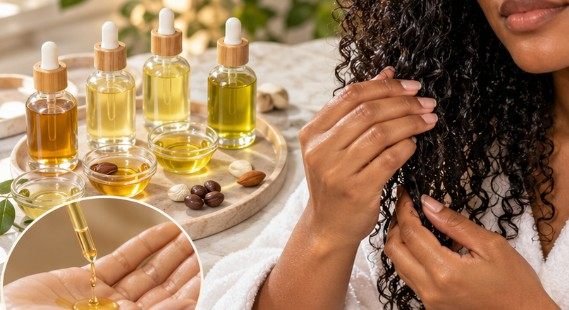
A flaky scalp does not automatically mean your skin is dry. In fact, adding more oils and moisturizing products can sometimes make the problem worse if residue is already coating your scalp.
Learning how to tell if you have hair buildup vs dry scalp starts with three clues: what the flakes look like, how your roots feel, and what happens after you wash. Buildup typically leaves hair coated or heavy, while genuinely dry scalp tends to feel tight, irritated, and moisture-depleted.
There is one complication worth knowing from the start: dandruff and seborrheic dermatitis can mimic both conditions. The American Academy of Dermatology notes that several scalp problems produce overlapping itching and flaking symptoms, which is why persistent symptoms sometimes require a dermatologist rather than another new shampoo.
What Hair Buildup Actually Looks and Feels Like
Scalp and hair buildup develops when materials accumulate faster than ordinary washing removes them. That layer can contain sebum, dead skin cells, styling creams, silicones, oils, sweat and dry shampoo. The clearest clue is often the hair itself.
Roots may become flat soon after washing. Individual strands can feel waxy, sticky or coated rather than freshly clean. Hair may resist absorbing water or styling products and lose some of its usual bounce and movement.
The American Academy of Dermatology explains that shampooing the scalp helps remove excess oil, dead skin and accumulated hair products. It also warns that dry shampoo is not a replacement for washing with shampoo and water because dry shampoo itself can accumulate.
Buildup particles may also remain attached to the scalp or hair instead of floating onto your shirt. You may notice residue beneath your fingernails after scratching your scalp.
Product Buildup Is Not the Only Source
People who use leave-in conditioners, edge-control products, styling waxes, oils or dry shampoo frequently have an obvious source of residue. But your water can play a role too.
Research indexed by the National Library of Medicine has demonstrated that calcium and magnesium can deposit on hair exposed to hard water, although studies disagree about how much this translates into measurable hair damage.
If your shower fixtures develop visible mineral scale and your hair routinely feels rough or coated despite washing, read this guide to hair care with hard water before assuming your scalp simply needs more moisture.
What a Truly Dry Scalp Feels Like
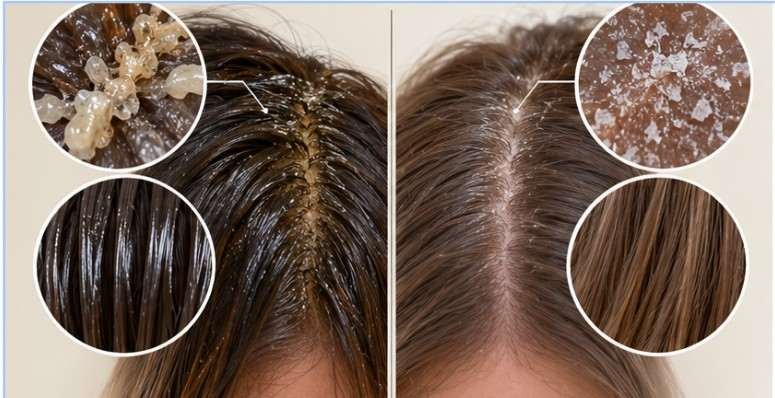
Dry scalp is fundamentally a skin-moisture problem. Cleveland Clinic describes it as a condition in which the scalp loses too much moisture, resulting in irritation, itching and flaking. Weather, age, hair products and certain skin conditions can contribute.
Instead of feeling greasy or coated, your scalp may feel tight after shampooing. Flakes are often fine, light and easy to brush from the hair. You may notice more symptoms during winter or in air-conditioned environments where humidity is low.
Dryness elsewhere is another useful clue. Someone dealing with dry hands, legs or facial skin at the same time may be experiencing generalized skin dryness rather than residue alone.
Harsh cleansing can intensify the cycle. If each shampoo leaves your scalp feeling noticeably tighter or stingy, repeatedly reaching for stronger clarifying products is unlikely to help.
Buildup vs Dry Scalp: The Fast Comparison
| Sign | More Suggestive of Buildup | More Suggestive of Dry Scalp |
| Flakes or residue | Sticky, waxy or attached | Fine, light and powdery |
| Roots | Greasy, heavy or coated | Dry or tight |
| Hair after washing | Still dull or weighed down | Cleaner but scalp may feel tight |
| Common triggers | Dry shampoo, oils, styling products, infrequent cleansing | Cold weather, harsh shampoo, low humidity |
| First approach | Thorough cleansing and less product layering | Gentle cleansing and moisture support |
These signs are useful clues rather than a medical diagnosis. Flaking scalp conditions overlap much more than beauty-product labels sometimes suggest.
The Two-Wash Test: A Practical Way to Investigate
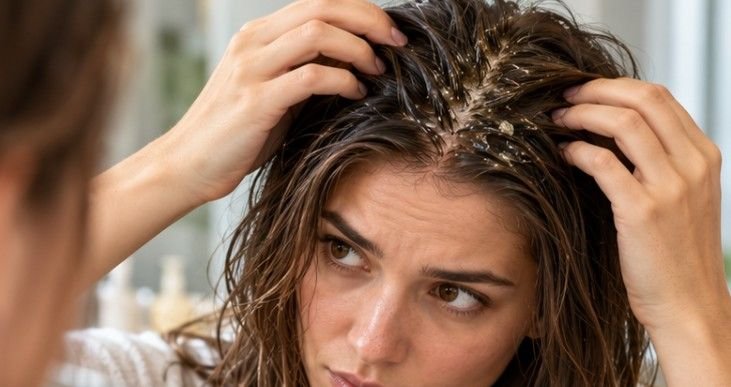
If you are trying to work out how to tell if you have hair buildup vs dry scalp, change one variable at a time rather than applying several treatments simultaneously.
Start with a normal wash focused primarily on the scalp. Massage shampoo through the roots and rinse extremely thoroughly. The AAD notes that leftover shampoo itself can irritate the scalp, so incomplete rinsing can muddy the picture.
If your hair still feels coated, perform your next scheduled wash with an appropriate clarifying shampoo. Avoid loading the scalp with oils, dry shampoo or heavy styling products afterward.
Then observe it for several days.
If your roots suddenly feel lighter, cleaner and more mobile while the visible residue decreases, buildup was probably contributing.
If stronger cleansing increases tightness, itching and powdery flakes without solving the problem, dryness or another scalp condition becomes more plausible. Switch back to a mild shampoo rather than repeatedly clarifying.
This is intentionally a short experiment. Aggressive clarifying every day can create irritation and make the original diagnosis even harder.
The Third Possibility: It May Be Dandruff
One of the biggest scalp-care mistakes is assuming every white flake means dehydration. Dandruff is commonly associated with seborrheic dermatitis. MedlinePlus describes seborrheic dermatitis as an inflammatory condition capable of producing white or yellowish scales on oily areas, including the scalp. The scales may be oily or sticky rather than simply dry.
DermNet likewise describes dandruff as a scalp manifestation within the seborrheic dermatitis spectrum. That creates an important contradiction: your scalp can look flaky while being relatively oily. For mild dandruff, the AAD recommends dandruff shampoos containing active ingredients such as ketoconazole, selenium sulfide, salicylic acid, sulfur, zinc pyrithione or coal tar, depending on the product and individual needs. That is very different from treating uncomplicated dry skin with increasingly rich scalp oils.
What to Change Once You Know the Likely Cause

For buildup, simplify first. Reduce unnecessary product layering, shampoo the scalp thoroughly and make sure styling products are actually being washed out rather than continually reapplied.
People who rely heavily on dry shampoo should remember that it absorbs oil but does not physically clean the scalp. The AAD recommends regular washing with shampoo and water to remove dry shampoo, dead cells, oil and microorganisms.
For dry scalp, move in the opposite direction. Choose a gentler shampoo, avoid excessively hot water and reconsider products that leave the skin stripped or irritated.
Be cautious about using concentrated essential oils directly on an already irritated scalp. If you’re considering botanical treatments, understanding safe dilution and expectations matters; this overview of rosemary oil for hair growth explains the topic in more detail.
When Flaking Needs More Than Home Troubleshooting
Scalp psoriasis, eczema, allergic contact dermatitis, fungal infections and seborrheic dermatitis can all produce itching or scaling.
See a health professional or board-certified dermatologist if you develop significant redness, swelling, pain, sores, thick plaques, bleeding, pus, patches of broken hair or hair loss. Persistent symptoms that do not improve after changing your routine also deserve evaluation.
The AAD specifically notes that scalp psoriasis may produce thicker scale and that scalp ringworm can cause scaly patches accompanied by broken hairs or hair loss.
FAQs
1. Can you have dry scalp and product buildup at the same time?
Yes. Product residue can accumulate while the underlying skin is dry or irritated. That is why root texture, cleansing response and overall scalp condition should be considered together.
2. Does an oily scalp mean I cannot have flakes?
No. Dandruff and seborrheic dermatitis frequently involve oily areas of skin and can still cause obvious white or yellowish scaling.
3. How often should I clarify buildup?
There is no universal schedule. Clarify when your routine and hair type require it rather than automatically doing it daily or weekly. Over-cleansing may aggravate dryness.
4. When should I see a dermatologist?
Seek professional evaluation for persistent symptoms or significant redness, pain, sores, thick scales, infection signs, broken hairs or unexplained hair loss.
Read Your Scalp Before Reaching for Another Product
The most useful lesson is that flakes alone tell you surprisingly little. Their texture, the condition of your roots and the way your scalp responds to cleansing provide much better evidence. Once you understand how to tell if you have hair buildup vs dry scalp, treatment becomes far less experimental. Coated, heavy roots usually call for better removal of residue; tight, moisture-starved skin needs gentler care. And oily, stubborn scaling may point toward dandruff rather than either one.
Instead of covering the symptom with another layer of product, identify what your scalp is actually telling you first.