

A split end is not simply “dry hair.” It is a structural fracture in a strand that has already spent months—or years—being washed, brushed, heated, colored, slept on, tied up, and exposed to sunlight.
That distinction matters. Once a strand has physically split, no conditioner can permanently weld it back together. But learning how to prevent split ends without losing length does not mean surrendering several inches at every salon visit. The smarter approach is to protect vulnerable ends, reduce repeated damage, and remove individual splits before they travel farther up the shaft. For anyone trying to grow longer hair, length retention matters almost as much as growth itself.
Why Long Hair Develops Split Ends So Easily
The ends are the oldest part of your hair. Hair emerging near your scalp has had relatively little exposure to mechanical and environmental stress. The final few inches may have endured hundreds of washes, thousands of combing passes, hot tools, chemical processing, UV exposure, chlorine, friction from clothing, and nighttime movement.
Research on hair weathering published through the National Library of Medicine describes progressive deterioration toward the distal—or farthest—portion of long hair. As the protective cuticle wears away, the underlying cortex becomes more vulnerable to longitudinal cracking.
That is why simply applying more moisturizer is not always enough.
Think of length retention as damage budgeting. Every aggressive detangling session, scorching flat iron pass, bleach appointment, and rough towel dry spends a little of the hair fiber’s remaining structural strength.
Stop Treating the Ends Like the Scalp
One of the easiest improvements starts in the shower. Apply shampoo primarily where oil, sweat, skin cells, and styling residue collect: the scalp. There is usually no reason to vigorously scrub the oldest portion of your hair between your hands.
The American Academy of Dermatology’s healthy-hair guidance recommends concentrating shampoo on the scalp and using conditioner after washing. For fine or straight hair, conditioner can be concentrated toward the ends; dry or curly hair may benefit from conditioning more of the length.
If your ends repeatedly feel rough immediately after washing, your cleansing technique may be contributing to the problem.
Give the Bottom Third Extra Protection
Conditioners, leave-ins, smoothing serums, and a small amount of oil can decrease friction and improve manageability.
They do not permanently repair a split shaft. Their value is preventive: smoother strands require less force to separate during detangling and rub against neighboring hairs less aggressively.
The American Academy of Dermatology also notes that leave-in conditioner can be particularly useful for long, dry, brittle, curly, heat-styled, or color-treated hair.
A light pre-wash oil treatment can also be useful for very dry ends. Apply a small amount before shampooing rather than saturating the scalp. Coconut, argan, or similar cosmetic oils may reduce roughness for some hair types, but oil should be viewed as a protective grooming aid, not a cure for existing splits.
Use the End-Up Detangling Rule
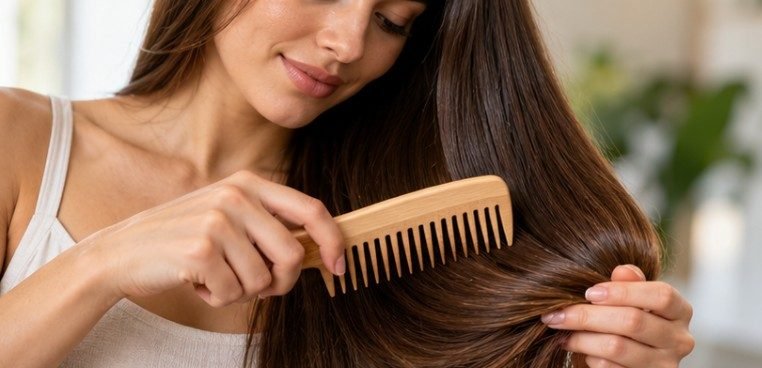
Trying to drag a comb from the roots through a knot transfers force directly into fragile areas. Instead, divide the hair into manageable sections and begin detangling the final few inches. Once they move freely, work progressively higher.
The American Academy of Dermatology recommends slowly combing the ends first before moving upward. It also highlights an important distinction: straight hair is often better allowed to dry somewhat before combing, while tightly curled or textured hair may experience less breakage when detangled wet and conditioned.
That nuance matters. There is no universal rule that everyone should brush hair wet—or everyone should avoid it.
Your Length-Retention Damage Check
Use this simple comparison to find where unnecessary damage may be occurring.
| Habit | Higher-Damage Version | Length-Friendly Version |
| Washing | Scrubbing shampoo through the ends | Cleanse mainly at the scalp |
| Detangling | Pulling from roots downward | Work from ends upward |
| Drying | Rubbing with terrycloth | Blot with microfiber or a T-shirt |
| Heat | Maximum temperature repeatedly | Lowest effective temperature |
| Sleeping | Loose hair rubbing on bedding | Low-friction, loosely secured style |
| Trimming | Waiting for major damage | Small, targeted maintenance trims |
If three or more habits fall into the middle column, changing your handling routine will probably protect more length than adding another expensive treatment.
Heat Damage Adds Up Faster Than You Think
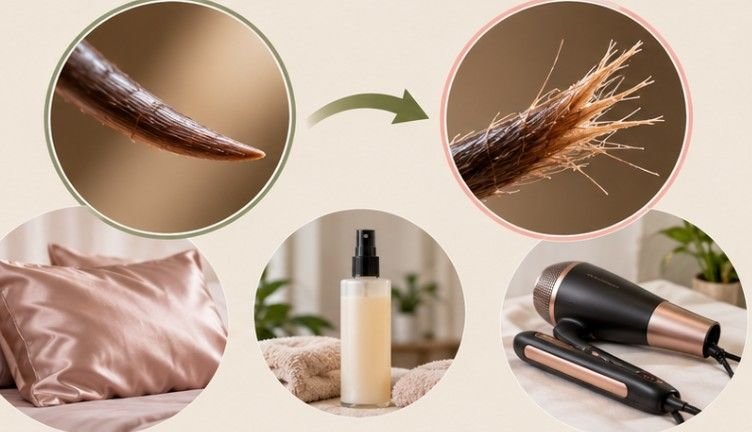
Hair does not regenerate after leaving the follicle. Unlike skin, the visible shaft cannot heal itself biologically. MedlinePlus information on fragile hair shafts lists blow-drying, ironing, excessive brushing, perms, and heavy chemical use among factors that can contribute to weak points and breakage.
That does not mean abandoning styling tools completely. Use heat protectant, allow hair to partially air-dry when practical, select the lowest effective temperature, and avoid repeatedly passing an iron over the same section.
Harvard Health guidance on hair damage also identifies extreme heat, twisting, bleaching, coloring, and permanent-wave treatments as sources of traumatic hair damage. Protecting length becomes especially important when several stressors overlap—for example, highlighted hair that is also straightened several times each week.
Reduce Damage While You Sleep
Seven or eight hours of small movements against a rough pillowcase creates repeated friction. A silk or satin pillowcase, bonnet, or scarf can provide a smoother surface, particularly for curly, textured, chemically processed, or very long hair. A loose braid or similarly low-tension protective style may also prevent ends from tangling during the night.
Avoid securing hair so tightly that the solution creates another problem. Constant tension from tight ponytails, braids, extensions, and buns can contribute to breakage and traction-related hair loss. Dermatologists specifically warn against repeatedly wearing styles that pull strongly on the hair.
Remove Damage Without Sacrificing Inches
This is where how to prevent split ends without losing length becomes practical rather than theoretical. You do not necessarily need a major haircut every time a handful of splits appear.
Try Hair Dusting
Dusting removes tiny damaged tips rather than changing the overall haircut. A stylist can inspect small sections and snip only clearly frayed ends with sharp professional shears. Some people twist small sections so split fibers become more visible.
The important word is small. If an inch or more is being removed everywhere, you are getting a trim rather than a true dusting. Never use dull household scissors. A poor blade can crush the shaft instead of leaving a clean edge.
What About Split-End Trimming Devices?
Mechanical split-end trimmers are designed to remove protruding tips while preserving most overall length. They may appeal to people maintaining very long hair, but results depend heavily on device quality, technique, hair texture, and existing damage.
Independent clinical evidence for consumer split-end devices is limited, so they should not be considered superior to careful professional trimming.
Serums containing silicones can also make splits look smoother temporarily. That cosmetic improvement is useful, but once the product washes away, the underlying fracture remains.
Know When You Need More Than a Hair-Care Routine

If hair suddenly begins breaking close to the scalp, feels dramatically weaker than usual, or appears unable to retain any length despite gentle handling, do not automatically assume you simply need another mask.
MedlinePlus notes that unusual hair fragility can occasionally accompany nutritional deficiencies, thyroid problems, inherited hair-shaft disorders, and other medical conditions. A dermatologist can help distinguish ordinary weathering from a hair or scalp disorder.
ColumbiaDoctors advice on evaluating unhealthy hair also recommends medical evaluation when unusual shedding occurs or persistent scalp pain, itching, or rash accompanies hair problems.
Pay attention to the scalp as well as the ends. These guides to signs of an unhealthy scalp and the potential side effects of aloe vera on hair are useful if scalp treatments or DIY remedies are already part of your routine.
FAQ
1. Can split ends actually be repaired without cutting them?
No. Conditioners, oils, proteins, and silicones can temporarily smooth or coat damaged fibers, but a physically split strand cannot permanently fuse itself back together.
2. How often should I dust my hair?
There is no universal schedule. Inspect your ends periodically and remove visible splits before they progress. People who bleach, chemically straighten, or frequently heat-style may require more frequent maintenance.
3. Does cutting split ends make hair grow faster?
No. Cutting affects the hair shaft, not follicle growth. Trimming can make hair appear to grow better because reducing breakage helps you retain more of the length you produce.
4. Should I cut every split end I find?
Visible, clearly fractured ends are worth removing. However, obsessive daily trimming can sacrifice unnecessary length. Focus first on reducing the habits causing repeated damage.
Protect the Hair You Already Grew
Growing long hair is only half the equation. Keeping it intact is the harder part. The most reliable approach to how to prevent split ends without losing length is surprisingly unglamorous: shampoo the scalp instead of scrubbing the ends, condition vulnerable lengths, detangle gently, control heat, reduce nighttime friction, and remove small splits before they become larger fractures.
Products can improve softness and appearance, but technique determines how much accumulated wear your hair experiences.
Treat the final few inches as something irreplaceable. They took years to grow. Protecting them every day is far easier than trying to rescue them after the shaft has already split.







