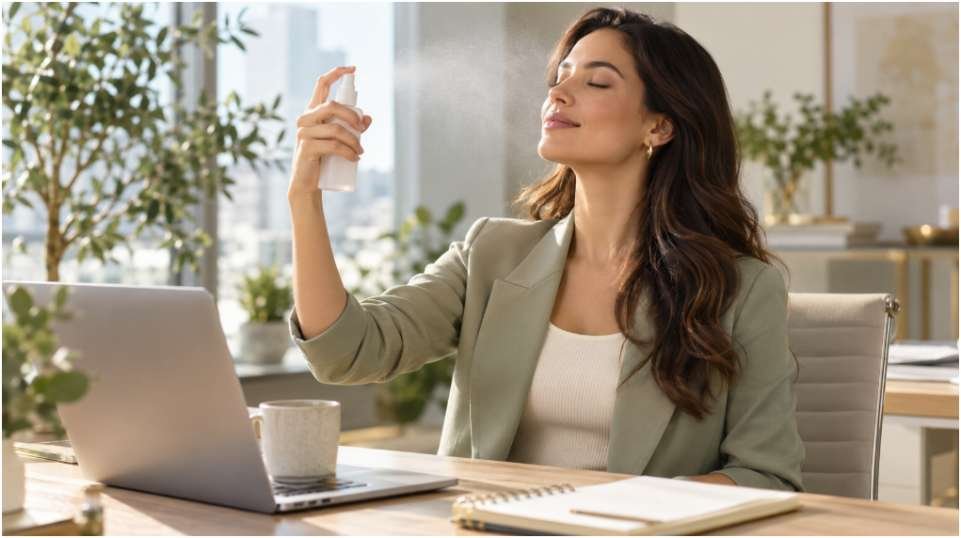
By 2:00 PM under commercial air conditioning, my cheeks used to feel like stretched parchment. If you spend eight hours in a corporate building, you know that tight, itchy sensation that settles across your forehead and cheeks before the afternoon slump even hits. Finding the best hydrating face mists for dry office air changed my workday skin entirely, but only after I stopped making the single biggest mistake people make at their desks: spraying pure water onto bare skin.
Commercial HVAC systems aggressively siphon water out of indoor air. After placing a digital hygrometer next to my monitor, I watched the relative humidity plunge from an ambient 52% outdoor level to a desert-dry 21% at my cubicle. In that environment, using the wrong spray does not hydrate you—it speeds up transepidermal water loss. The right formula needs to bind water and lock it down with lipids.
The Office Microclimate: Why Your AC Is Siphoning Skin Moisture

Air conditioners cool spaces by condensing moisture out of the air. When relative indoor humidity falls below 40%, the air seeks equilibrium by pulling water from the most available source around: your stratum corneum.
The Journal of Investigative Dermatology documented that low ambient humidity rapidly accelerates trans-epidermal water loss (TEWL) while reducing skin elasticity. Further clinical research indexed by the National Center for Biotechnology Information (NCBI) highlights how indoor climate controls amplify barrier fatigue and increase skin sensitivity throughout prolonged workdays.
The Flash-Evaporation Trap of Thermal Waters
Most people reach for a French pharmacy aerosol can filled with pure thermal water when their skin feels tight. In an office setting, that is the worst thing you can do.
Pure water contains minerals, but it lacks film-forming lipids. When you spray water into 20% humidity, that fine liquid evaporates within ninety seconds. As it flashes off, it takes your skin’s native hydration with it.
You end up in a rebound cycle: spritz, feel tight, spritz again, and leave your face drier than when you started. If your goal is to repair damaged skin moisture barrier damage caused by months of harsh office air, you need mists with structural lipid backing.
What Makes an Office-Proof Face Mist Formula
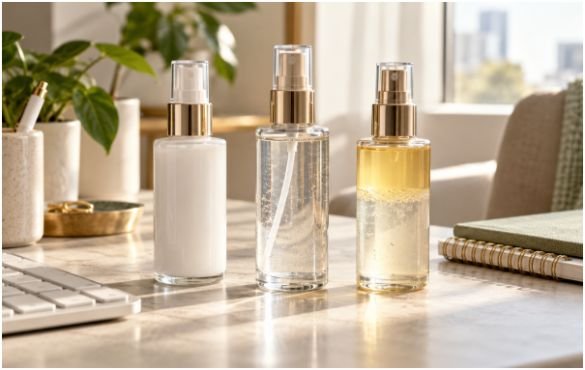
An effective desk mist must combine two distinct chemical actions: water-binding and barrier-sealing.
┌────────────────────────────────────────────────────────┐
│ THE DUAL-ACTION OFFICE MIST │
└──────────────────────────┬─────────────────────────────┘
│
┌────────────────────────┴─────────────────────────┐
▼ ▼
┌───────────────┐ ┌───────────────┐
│ HUMECTANTS │ │ OCCLUSIVES │
├───────────────┤ ├───────────────┤
│ Glycerin │ ── Draws moisture into ────────> │ Ceramides │ ── Seals hydration
│ Beta-Glucan │ upper skin layers │ Plant Oils │ against dry AC
│ Hyaluronic │ │ Squalane │ evaporation
└───────────────┘ └───────────────┘
Humectants That Anchor Water
Glycerin, beta-glucan, panthenol (provitamin B5), and sodium hyaluronate draw ambient water molecules into the upper epidermis. When used in home skincare, you always use hyaluronic acid serum on damp skin so the molecule grabs free water rather than pulling from your dermis. In a dry office, your mist bottle must supply that moisture vehicle itself.
Emollients and Lipids That Seal It
To survive continuous airflow from overhead vents, you need micro-emulsified lipids. Look for:
- Ceramides (NP, AP, EOP): Intercellular glue that prevents water leakage.
- Squalane: A light, biocompatible emollient that cushions without clogging pores.
- Lightweight botanical oils: Meadowfoam seed, avocado, or jojoba oil suspended in water to form a non-greasy lipid screen.
The Tested Lineup: Best Hydrating Face Mists for Dry Office Air
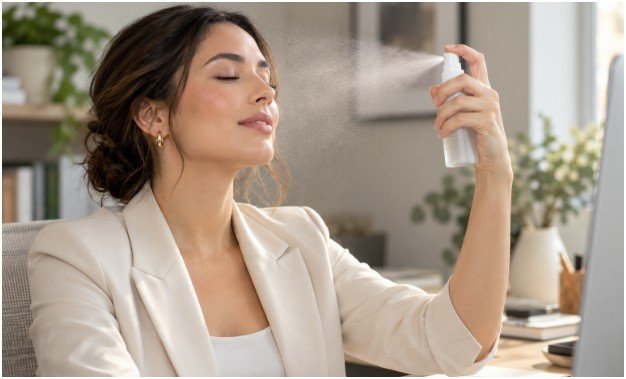
I spent three months testing formulas at my desk under constant 68°F (20°C) air conditioning. These five options restored comfort, kept my makeup intact, and prevented afternoon tightness.
| Mist Formula | Best For | Standout Actives | Finish on Skin |
| Aestura Atobarrier 365 Cream Mist | Severe dryness, compromised barriers | 10,000 ppm ceramides, squalane | Velvety, liquid-cream shield |
| d’Alba White Truffle First Spray Serum | Midday dullness, tired complexions | White truffle, avocado oil, niacinamide | Luminous, dewy glow |
| Laneige Cream Skin Mist | Long-lasting barrier cushion | Cerapeptide, white leaf tea water | Plump, semi-dewy comfort |
| Holika Holika Good Cera Mist | Reactive skin, stinging sensations | Ceramides, fermented lipids, bergamot | Soft matte, soothing veil |
| Pixi Hydrating Milky Mist | Budget-friendly desk staple | Hyaluronic acid, black oat, provitamin A | Lightweight hydration |
Aestura Atobarrier 365 Cream Mist
This formula operates like a rich barrier cream dissolved into a cloud of micro-droplets. Containing 10,000 ppm of skin-identical ceramides, it coats the face in a flexible lipid shield. Whenever cold vents blow directly onto my workstation, two pumps immediately eliminate dry flaking without shifting concealer or leaving grease.
d’Alba White Truffle First Spray Serum
Known in South Korea as the “in-flight mist” among flight attendants, this bi-phase spray pairs a yellow oil layer with an antioxidant nutrient essence. You give the bottle a light shake to create an emulsion before misting. It sinks straight into tired skin, restoring radiance while keeping office air from sapping the cheekbones.
Laneige Cream Skin Mist
This cult-classic toner mist uses micro-blending technology to deliver a jar of ceramide moisturizer in liquid form. The nozzle creates a diffuse, ultra-fine fog that settles weightlessly over cosmetics. It forms a cushion against dry air that lasts three to four hours per application.
Holika Holika Good Cera Super Ceramide Mist
Formulated at an optimal pH of 5.5, this ceramide-rich mist suits reactive skin prone to redness under office fluorescent lights. Its fermented lipid complex supports the natural stratum corneum, calms irritation quickly, and leaves a balanced finish with zero tackiness.
Pixi Hydrating Milky Mist
For a straightforward, accessible humectant mist, Pixi blends hyaluronic acid with oat kernel extract. The milky suspension cushions dehydrated skin during long spreadsheet sessions. It offers a gentle moisture replenishment step for normal-to-dry complexions on a budget.
How to Layer and Spritz at Your Desk Without Ruining Makeup
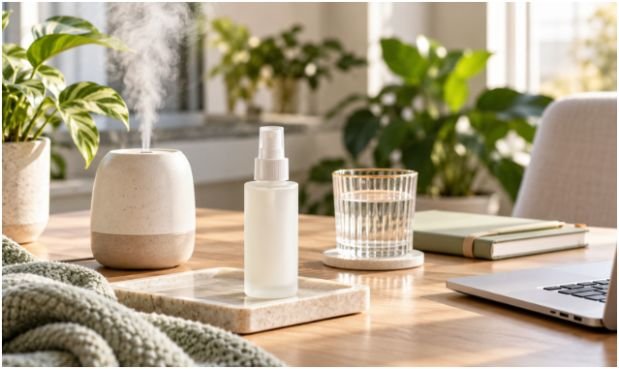
Technique determines whether your face mist protects your skin or turns foundation patchy. The American Academy of Dermatology (AAD) emphasizes sealing moisture quickly before indoor drafts cause evaporation.
- Step away from direct drafts: Lean back from your desk so overhead air vents do not blow directly at your face while spraying.
- Shake bi-phase bottles: Blend oil and water phases thoroughly to disperse the lipids evenly.
- Keep proper distance: Hold the nozzle eight to ten inches away. You want a soft veil settling on your face, not large droplets pooling on skin.
- Mist in a cross pattern: Spray once across your forehead and once vertically down your nose and chin.
- Press, never rub: Let the mist settle naturally for ten seconds. If you have foundation on, gently press clean palms or a beauty sponge onto dry areas to anchor the emulsion into your base makeup.
Frequently Asked Questions
1. Can I just use rosewater as a face mist in an office?
Plain rosewater lacks occlusive lipids, causing it to evaporate rapidly and increase dryness under office air conditioning.
2. How often should I mist my face at work?
Spritz two to three times a day—mid-morning and mid-afternoon—whenever your skin begins to feel tight.
3. Will milky or bi-phase face mists break down my foundation?
Fine-nozzle milky mists melt powders into skin for a fresh finish without breaking down long-wear makeup.
4. What is the difference between setting spray and hydrating face mist?
Setting sprays contain polymers to lock makeup in place, whereas hydrating mists supply lipids and humectants to nourish skin.
Ditch the Desert Desk: Your Next Step
Dry air conditioning does not have to dictate how your skin looks by 5:00 PM. The secret is swapping watery aerosols for milky, ceramide-rich, or bi-phase formulations that lock in hydration.
Select a dedicated barrier mist, set it next to your keyboard, and give your skin a defensive spritz before your 2:00 PM meetings. Pair your new desk mist with a compact personal humidifier to stay hydrated through every workday.