I spent years wondering why my foundation looked cracked by noon despite spending hundreds on luxury beauty products. Every time I layered heavy creams and glowing oils, my base rolled off into tiny gray balls across my jawline.
Finding the best morning skincare routine for glowing skin under makeup comes down to one principle: lightweight, water-based hydration beats heavy surface oils every time.
Cosmetics need an even, pliable canvas to grip properly. When you prioritize cellular bounce over dense occlusives, your skin reflects light through your foundation instead of breaking down the pigments beneath it.
Why Traditional Morning Skincare Causes Foundation Pilling
Most morning routines fail because they stack thick humectants that never sink in. When makeup separates or cakes, the culprit is rarely the foundation itself. It is usually the chemical traffic jam sitting directly underneath it.
The Trap of High-Molecular-Weight Hyaluronic Acid
High-molecular-weight hyaluronic acid forms an invisible, flexible film over the outer layer of the skin. If that film dries down into a tight sheet and you buff a dense foundation brush over it, friction tears the layer apart.
That physical shear causes immediate pilling. To avoid this, select low-molecular-weight humectants like glycerin, ectoin, or beta-glucan. These draw water deep into tissue without drying into a fragile surface crust.
Emulsion Clash: Silicone vs Water Bases
Water and oil do not mix, and cosmetic chemists formulate primers and foundations around specific binder systems. If your sunscreen is packed with water and volatile glycols, layering a cyclopentasiloxane-heavy primer over it makes the pigments slip and pool inside fine lines.
Matching your base formulas eliminates midday patchiness. If you prefer long-wear silicone cosmetics, make sure your hydrating skincare has absorbed completely before applying your base.
The 5-Step Morning Routine for a Seamless, Lit-from-Within Canvas
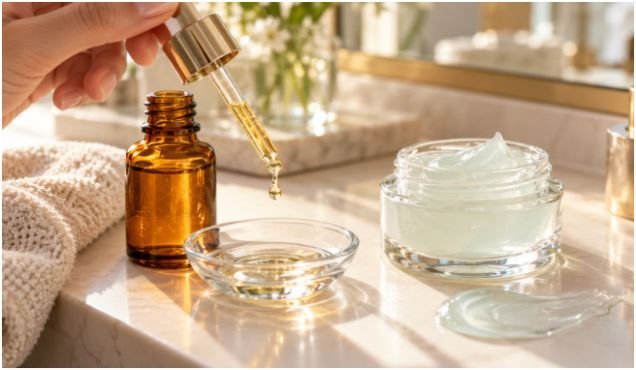
I follow this strict sequence every single morning before touching cosmetics. It focuses on progressive viscosity, moving from thinnest to thickest to build light-reflecting elasticity.
Cleanser (Low Foam) ➔ Essence (Micro-Humectants) ➔ Vitamin C (Antioxidant) ➔ Gel-Cream (Barrier Lock) ➔ Fluid SPF (Film Barrier)
Step 1: Gentle Barrier-Preserving Cleanse
Start by washing away overnight sebum without stripping your natural lipids. Skip aggressive foaming washes and scrubs in the morning.
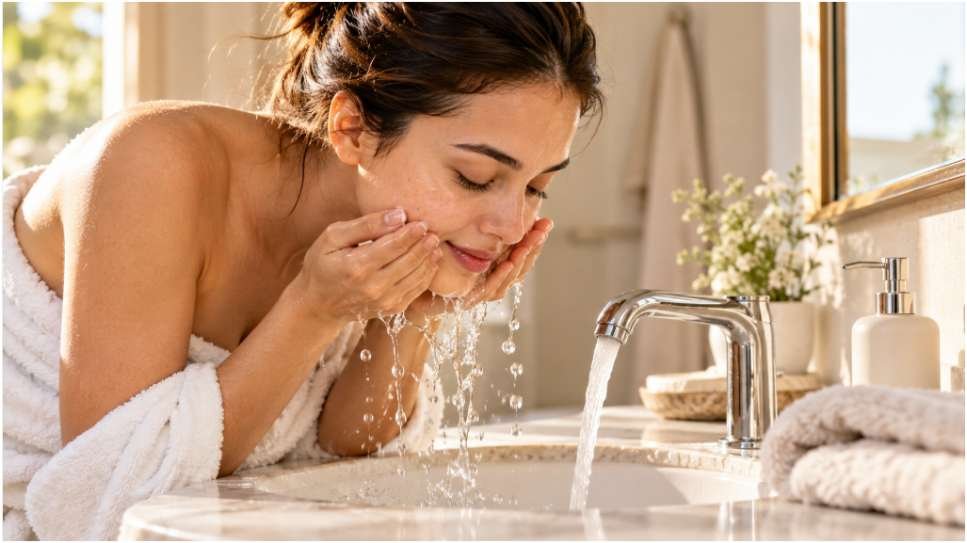
I use lukewarm water and a low-pH, non-foaming cream gel. If you have very dry skin, a gentle rinse with tepid water works best. Stripping your natural moisture barrier triggers rebound oil production, causing makeup to dissolve around your T-zone within three hours.
Step 2: Cellular Hydration via Micro-Essence
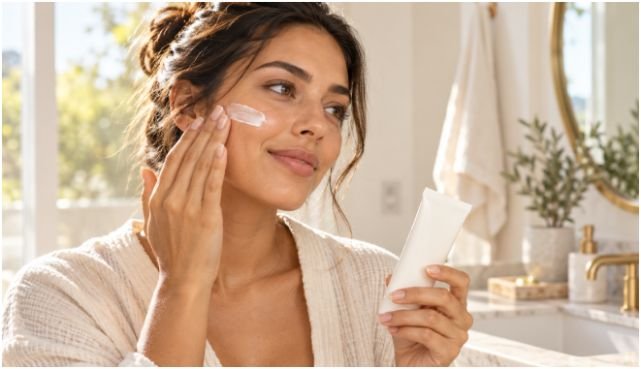
Never apply makeup to dehydrated skin. Damp skin acts like a sponge, pulling downstream active ingredients deep into the epidermis.
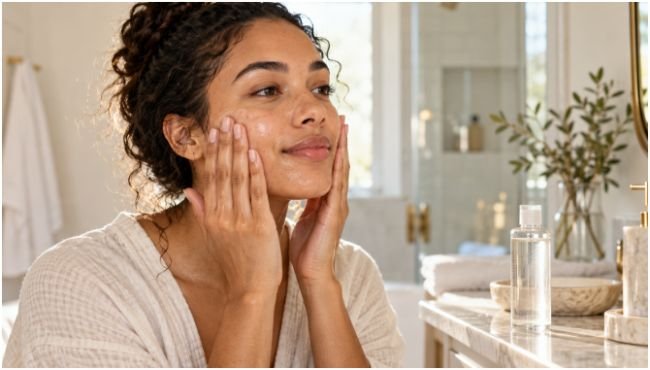
I splash on an alcohol-free essence rich in fermented bifida ferment or soothing rice water extract. Pat two layers into your face and neck with cupped palms until the surface feels slightly springy. Learning how to layer serums for glass skin look starts here with this essential watery cushion.
Step 3: Targeted Radiance with Low-pH Vitamin C
A pure 10% to 15% L-ascorbic acid serum provides antioxidant defense while brightening uneven spots. Research published in the Journal of Clinical and Aesthetic Dermatology highlights that topical vitamin C supports collagen synthesis and limits environmental free-radical damage.
I press three to four drops onto clean skin and let it absorb for sixty seconds. The slight tackiness creates an ideal gripping layer for downstream hydration without interfering with your makeup’s finish.
Step 4: Water-Gel Emulsion to Lock in Bounce
Trade heavy, oil-laden moisturizers for an oil-free water gel. Ingredients like squalane, ceramides, and panthenol nourish skin cells while drying down to a touchable, satin sheen.
Massage a pea-sized amount over your face using upward, lifting motions. Focus on the high points of your cheeks and forehead where you want natural radiance to catch the light.
Step 5: Fluid Sunscreen with a Non-Greasy Film
Sun protection is mandatory for healthy skin. The American Academy of Dermatology recommends daily broad-spectrum SPF 30 or higher to protect tissue from UV degradation.
Select an ultra-fluid, chemical or hybrid sunscreen that leaves no white cast or greasy slip. The U.S. Food and Drug Administration monitors sunscreen durability and formulation safety. Fluid sunscreens dry clear, leaving an even, glass-like finish that works like a natural makeup primer.
The Evaporation Window: Application Technique That Stops Separation
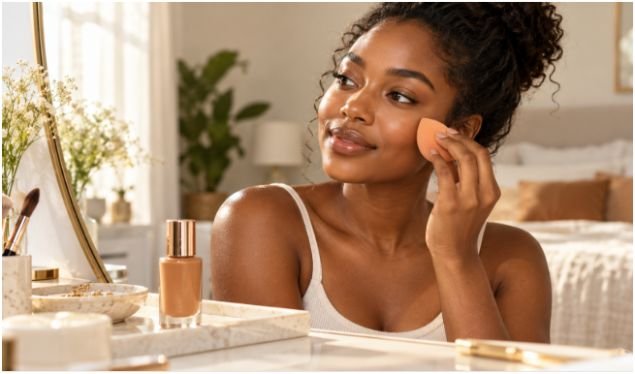
Timing matters just as much as your product list. Rushing straight from sunscreen to concealer is the fastest way to ruin your base.
Apply SPF Fluid ━━━► Wait 3–5 Minutes (Film Formation) ━━━► Stipple Base (Sponge/Brush)
Every quality sunscreen relies on volatile carrier fluids to distribute UV filters evenly across your face. As these liquids evaporate, they leave a thin protective membrane over the skin. If you brush foundation over damp sunscreen, you rupture this membrane.
Give your sunscreen three to five full minutes to set before starting your cosmetics. Once it dries down, switch from sweeping motions to gentle stippling with a damp beauty sponge to keep the base intact.
Frequently Asked Questions
1. Can I skip moisturizer if my sunscreen is hydrating?
Yes, if your sunscreen contains hydrating ingredients like hyaluronic acid or ceramides, skipping a separate moisturizer prevents excess buildup.
2. Why does my foundation separate on my nose and chin?
Makeup separates when excess oil breaks down foundation pigments or when heavy skincare steps fail to absorb fully before application.
3. How long should I wait between skincare and makeup?
Wait three to five minutes after applying sunscreen so your protective skincare layers can set before foundation.
4. Should I use face oil under foundation for extra glow?
Avoid morning facial oils because they break down cosmetic binders, causing base makeup to slide off prematurely.
Level Up Your Morning Prep
Ditching heavy creams in favor of lightweight, water-focused hydration will transform how your makeup looks and wears. Keep your active layers thin, match your formula bases, and give your sunscreen time to set. Your foundation will go on smoothly and stay radiant all day.