

Sunlight can change more than your hair color. Ultraviolet radiation can damage proteins in the hair fiber, roughen its protective outer layers, increase dryness, and accelerate color fading. Research has found that UVB is particularly associated with protein damage, while UVA plays a larger role in color changes.
That makes learning how to protect hair from sun damage especially useful before summer vacations, pool days, outdoor workouts, road trips, or simply months of intense sunshine.
The best strategy is surprisingly simple: reduce direct exposure, protect the scalp separately, use a leave-in barrier on the hair, and control the additional damage caused by chlorine, salt, heat styling, and dehydration.
What Sunlight Actually Does to Your Hair
Hair above the scalp is made primarily of keratinized tissue. Unlike living skin, a damaged hair shaft cannot biologically repair itself. Conditioning products can smooth, coat, lubricate, and strengthen the fiber temporarily, but badly weathered ends eventually have to grow out or be trimmed.
Scientific reviews of hair photodamage describe changes in hair proteins, pigment, surface texture, mechanical properties, and shine after prolonged solar exposure. Melanin provides some natural protection, which helps explain why color changes and visible photodamage can vary between different hair colors and types.
Bleached, highlighted, color-treated, chemically processed, very fine, or already-damaged hair deserves extra attention because its protective structure may already be compromised.
The Most Effective Protection Starts With a Physical Barrier
Beauty products are useful, but covering the hair is often the easiest way to substantially reduce direct exposure. A tightly woven wide-brimmed hat protects both your hair and portions of your scalp, face, ears, and neck. The American Cancer Society recommends a brim extending at least three inches around the hat for stronger sun coverage.
A scarf can also reduce exposure, particularly when the lengths are completely covered. If you are spending several hours outdoors, a hat marked UPF 50+ is an especially practical choice. Protective hairstyles help, too. A loose braid, low bun, or twist exposes less hair surface than leaving long hair loose while also reducing wind-related tangling.
Avoid extremely tight styles, however. Sun protection should not come at the cost of unnecessary pulling or tension on the hairline.
Treat Your Scalp and Hair as Two Separate Areas
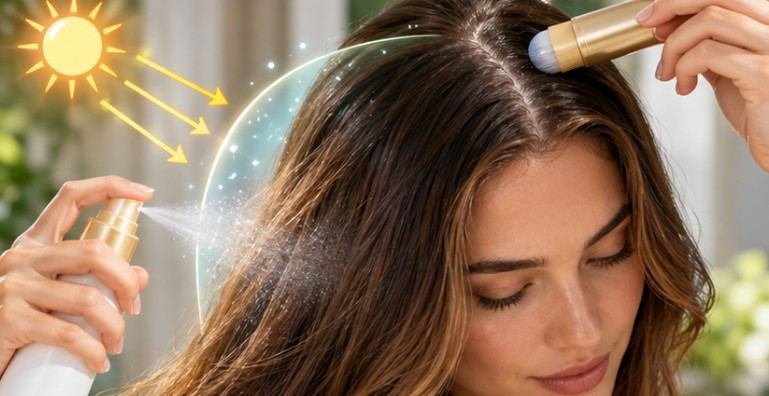
This is one of the biggest mistakes people make with sun protection. A UV-protective styling spray may help reduce cosmetic damage to hair, but it should not automatically be treated as sunscreen for exposed skin.
If your part, hairline, crown, or thinning areas are visible, the American Academy of Dermatology recommends broad-spectrum, water-resistant SPF 30 or higher on exposed scalp skin. Powder and spray formats can sometimes make scalp application easier.
People with thinning hair should be particularly careful because less hair means less natural coverage.
For long periods outdoors, a hat remains one of the easiest options because it protects without requiring you to work sunscreen between strands.
Use the UV Index as Your Hair Protection Trigger
You do not need to guess whether it is a high-exposure day. The Environmental Protection Agency’s UV Index runs from 1 to 11+, with higher numbers indicating stronger ultraviolet intensity. The agency recommends additional precautions once UV levels become moderate or higher and notes that UV exposure is generally strongest between 10 a.m. and 4 p.m.
Water, sand, and snow can also reflect UV radiation, making beaches, boats, pools, ski areas, and similar environments particularly important places to protect yourself.
A practical rule is simple: if you are planning prolonged outdoor activity during strong-UV hours, treat hair protection as part of getting ready rather than something you remember once your hair already feels dry.
Choose Hair UV Products for the Right Reason
Leave-in conditioners, sprays, creams, and styling primers containing UV filters can provide another layer of protection. Apply them evenly through exposed sections, particularly the outer layer, mid-lengths, and ends. Those areas often receive the most environmental wear.
One limitation deserves attention: hair UV products are not regulated and measured in the same standardized way as skin SPF. A scientific review of hair photoprotection notes that there is no universally regulated efficacy system allowing hair-sun products to be compared in the same way sunscreens can be compared by SPF.
So do not assume a bottle labeled “UV defense” makes your hair invulnerable. Think of it as one part of a broader strategy.
Protect Hair Before Swimming
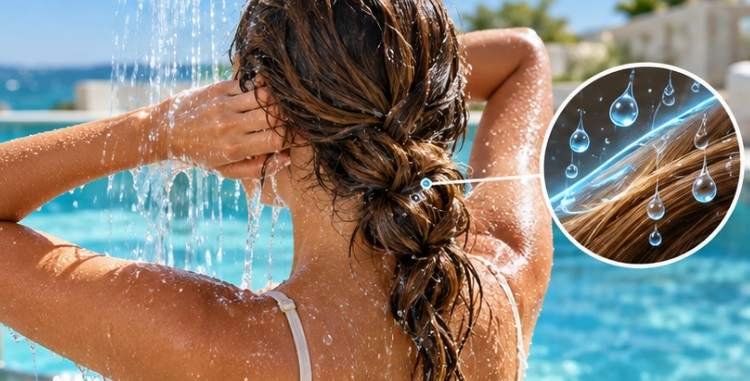
Pool and beach days create a double challenge because your hair may face sun exposure along with chlorine or salt water. Before swimming, thoroughly wet your hair with clean fresh water. Hair that has already absorbed clean water may take up less pool or ocean water.
You can then apply a leave-in conditioner, protective cream, or small amount of hair oil to the lengths. A swim cap offers even more protection.
After swimming, rinse your hair with fresh water as soon as practical. Chlorine, salt, minerals, sunshine, and repeated drying cycles can leave the hair feeling rough and difficult to detangle.
A clarifying or chelating shampoo can occasionally help swimmers remove accumulated deposits, but frequent aggressive cleansing may make already-dry hair feel worse.
Do Not Stack Sun Damage With Excessive Heat
Think of your hair as having a limited damage budget. If it has spent hours in intense sunshine, that may not be the best evening for repeated passes with a 400°F flat iron.
Cleveland Clinic advises minimizing excessive washing, bleaching, and high-temperature styling when trying to reduce sun-related hair damage. Conditioning and hair oils may also help keep the fiber lubricated and reduce dryness.
During sunny periods, air-drying partway, lowering tool temperatures, using heat protectant. And reducing the number of passes with hot tools can make your routine gentler.
Restore Moisture After High-Exposure Days
Conditioner becomes particularly important when hair is exposed repeatedly to sun, swimming, and heat. Use a moisturizing conditioner after shampooing and consider a deeper conditioning mask once weekly if your lengths begin feeling unusually rough. Concentrate richer formulas on the mid-lengths and ends rather than automatically coating the scalp.
Gentle detangling matters as well. Damaged wet hair can be vulnerable to mechanical stress, so start at the ends with a wide-tooth comb and gradually work upward.
Hair oils can improve lubrication and help reduce the dry sensation caused by weathering. If you are also interested in using botanical oils as part of a broader scalp routine, see this overview of rosemary oil for hair growth.
Frequently Asked Questions
1. Does sunscreen work on hair?
Dedicated UV-protective hair products may reduce cosmetic photodamage, but standard SPF ratings are designed for skin. Do not rely on a hair spray to protect exposed scalp.
2. Can coconut or argan oil protect hair from the sun?
Oils can lubricate hair and reduce moisture loss, but they should not replace a hat, UV-protective hair product, or proper sunscreen on exposed scalp skin.
3. How often should I reapply scalp sunscreen?
The American Academy of Dermatology recommends reapplying sunscreen approximately every two hours and after swimming or heavy sweating when skin remains exposed.
4. Does colored hair need more sun protection?
It is sensible to give dyed and bleached hair extra protection because sunlight can accelerate color fading while chemically processed strands may already be more vulnerable to dryness and breakage.
A Better Way to Think About Summer Hair Care
Knowing how to protect hair from sun damage is less about finding one miracle spray and more about preventing several small stresses from accumulating.
Cover your hair during long periods outside, protect exposed scalp with genuine sunscreen, use a UV-focused leave-in when appropriate, rinse promptly after swimming, and compensate for sunny days by reducing unnecessary heat and adding moisture.
The biggest improvement often comes from the simplest habit: check the UV Index before you leave home. If the day calls for sunscreen on your face, sunglasses, and shade, your hair and scalp probably deserve protection too.







